You closed on a wooded lot in an old subdivision and you want a house on it. Before a machine ever shows up, two things should exist: a survey with the corners found, and a house plan or a builder who knows where the house will sit. Adams Earthworx is Sam Adams, owner-operator out of Brooksville since 2016, serving Hernando, Pasco, Citrus and Marion counties. On a house lot he handles the machine side of land clearing: cutting, grubbing, rough grade and haul-off, all from one outfit.
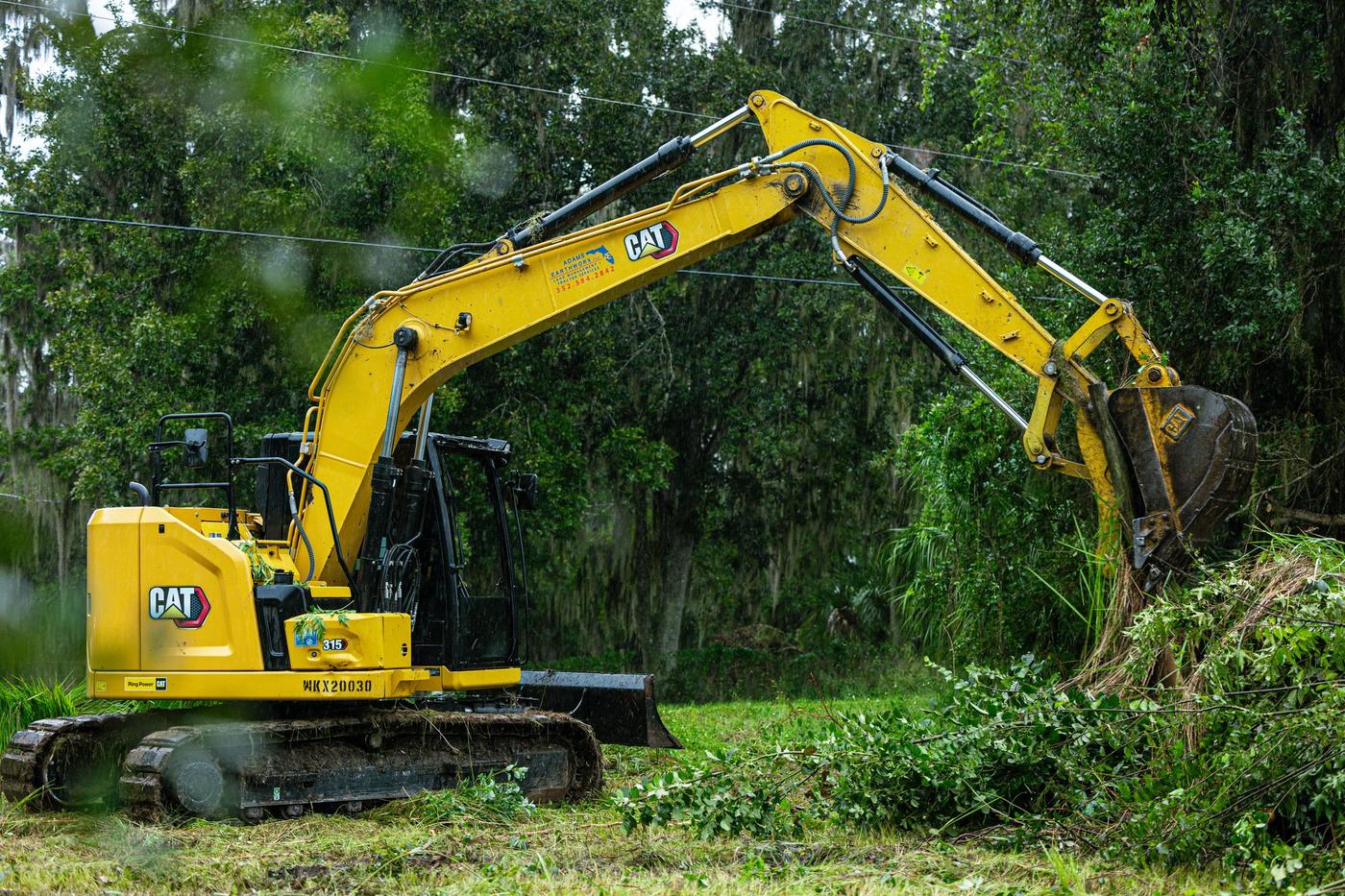
A subdivision lot is not raw acreage
Out on open acreage, the land decides most of the job. A platted lot is one drawn on the subdivision map, called the plat, that was recorded with the county, often decades ago. On a lot like that, most of the job was decided by whoever drew the map. The lot is a fixed rectangle. A paved or lime-rock road runs across the front with a swale beside it, the shallow grassy ditch along the road that carries rain away. Neighbors sit on two or three sides, some built, some still woods. And the county has a say in what share of it you strip bare.
People buy lots like this in Royal Highlands on the Weeki Wachee side of Hernando, in Citrus Springs, and in Marion Oaks. Listings in Royal Highlands commonly describe lots around 100 by 200 feet, a bit under half an acre, running up to about 1.2 acres, wooded with oaks, on well and septic. Three subdivisions, three counties, three sets of rules about trees and water. What they share is that the right amount of clearing is less than most buyers expect.
Clear the pieces, not the lot
Think of the lot as four pieces. Three of them get opened up. One gets left alone, or close to it.
- Where the house goes. The outline of the slab plus elbow room for the builder: forms, block trucks, a pump truck, a pallet of trusses. This is the one spot where stumps and roots get pulled out of the ground, not cut flush, because wood buried under a slab rots and leaves a soft spot. The difference between a cleared lot and a grubbed one is laid out in clearing vs. grubbing and the finishes you can ask for.
- The drive in from the street. A strip wide enough for a concrete truck, from the road edge to the house, including the spot where it rides over the front swale. That crossing has its own rules, covered in crossing the swale with your driveway. Once the strip is open, it can get driveway road base so trucks don’t rut it the first wet week.
- The septic and well spots. Your septic installer lays out the tank and drainfield, and the well goes where the setbacks put it. Those spots get settled on paper before any trees come down, which is why septic and well layout comes first.
- The yard you keep. Everything else. Palmetto and vines can come out by hand so you can see the ground, while the canopy stays put. Shade on the west side of a Florida house is worth more than an open lawn.
The sequence that keeps you out of trouble: survey and corner stakes, house placement from the builder or the plan, a walk with Sam, clearing to those lines, grubbing under the house, rough grade, then the brush and stumps leave on the truck. Clearing first and placing the house later is how people end up opening the lot twice.
Keeper trees and what the county may count
In Hernando, the single-family house permit packet includes a Landscaping Clearing Plan Application. It asks what percentage of the natural vegetation you are keeping, and how many big trees stand on the lot: specimen trees, 18 to 36 inches across at chest height, and majestic trees, 36 inches and up. The packet says those big ones need a protected tree removal permit before they come down. So measure the large oaks before anyone cuts anything, and keep that number with your survey. Check with your county first; bring it up when Sam walks the property.
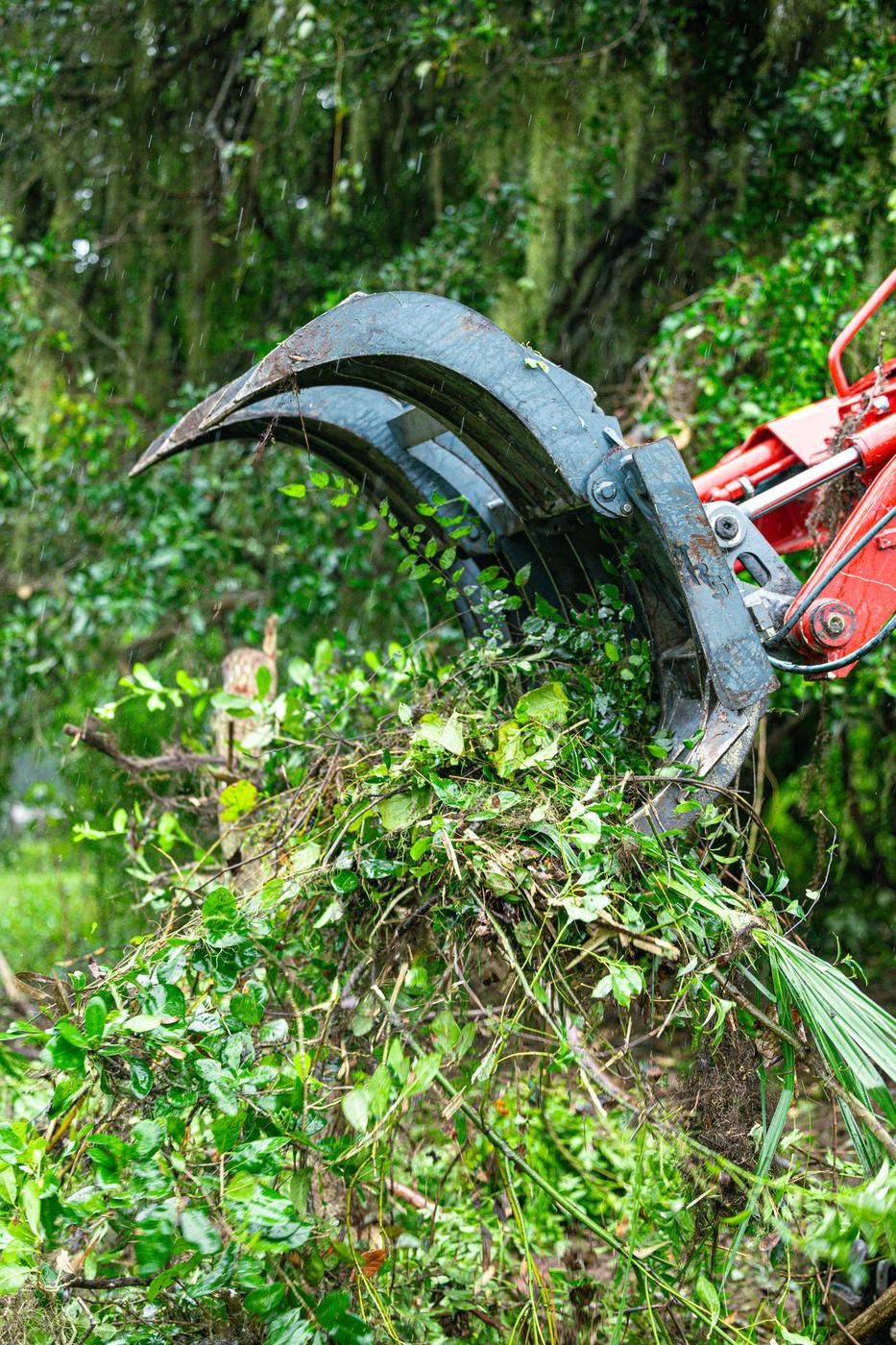
Which trees to keep is mostly common sense once the house is staked. Keep healthy oaks clear of the slab, the drive and the drainfield. Think hard about any limb that would hang over the roof, since that tree drops leaves in the gutters every year and becomes a worry every storm season. Point out every tree you want saved on the walk, and Sam flags it before work starts.
Working tight to a keeper is slower work. The grapple picks brush out from around the trunk instead of pushing it, and the Cat excavator stays back where it can. Where even a bucket is too much, the hand crew goes in with pole saws.

Your lot drains to the street
Here’s the part buyers miss. Rain that falls on a cleared subdivision lot does not just soak in and disappear. It heads for the swale out front, or for a shared swale along the line between you and the neighbor, and the house has to sit high enough that the water goes around it, not under it.
Hernando’s Standard Lot Grading Rules, in the same permit packet, spell it out. The house sits 12 inches above the swale flow line, meaning the bottom of that roadside ditch, all the way around. Side swales carry water to the front or the rear of the lot. And on a stretch where lots share a swale, the first house built has to establish its half of that common swale. If you are the first one building on your block, that half is on your lot, not your neighbor’s. Ask your builder what grades the plan calls for, and bring them when Sam walks the property.
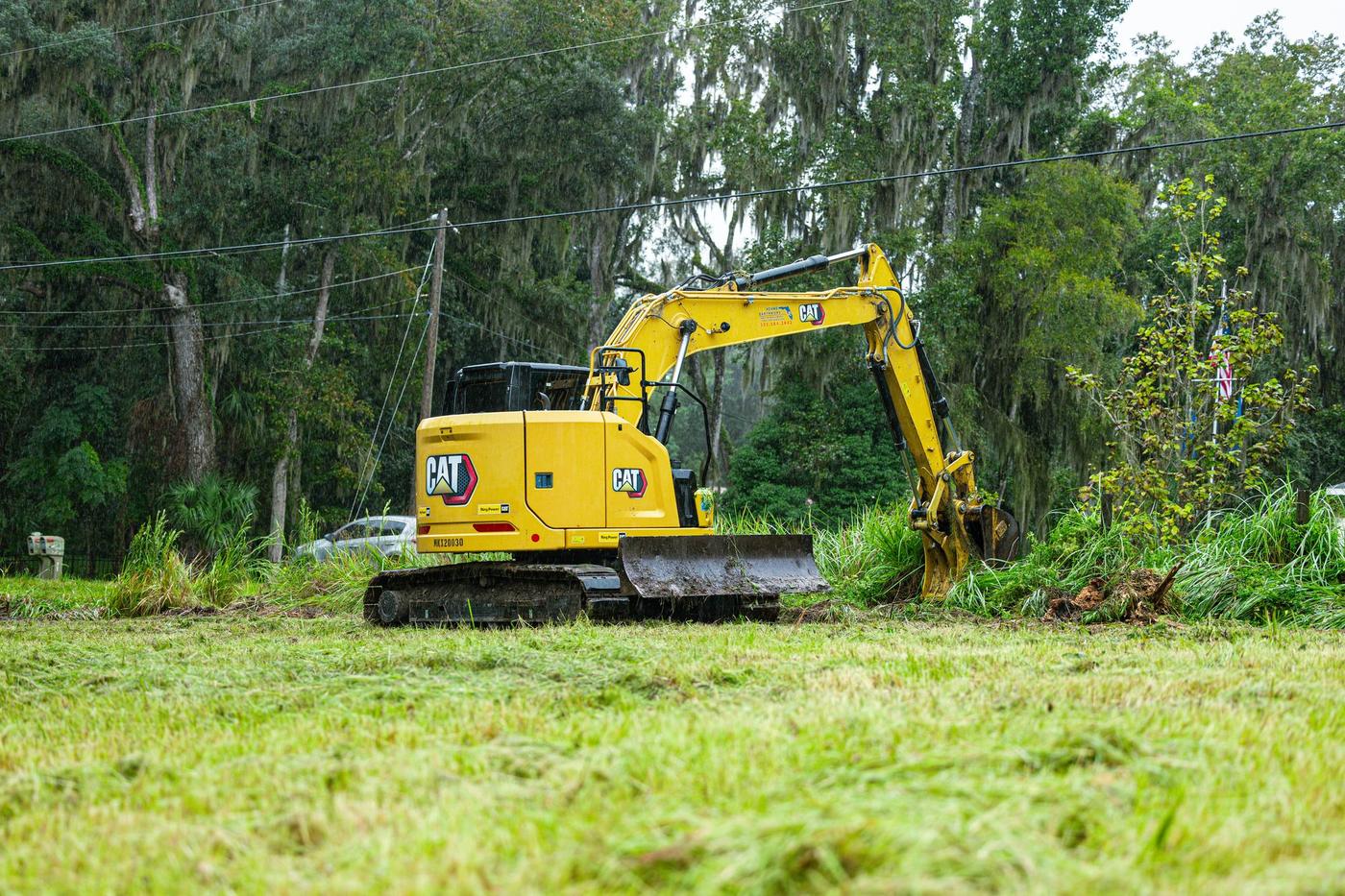
Sam’s part is the rough shape. Once the build area is open, he drops the blade, cuts the high spots, drags that sand into the low ones and leaves the ground tipped toward the swale, to the builder’s grades. Water already runs the right way before anybody sets a form board. More on that side of the work under grading and site prep.
Citrus and Marion do it their own way
Citrus. The county’s Tree Preservation Standards page says Citrus doesn’t issue stand-alone land-clearing permits. Permits are only issued if someone is going to build, and clearing trees without contacting the Building Division violates the county’s land development code.
In practice, that means the house permit comes before the trees come down. Recent Citrus house permits in the county portal also note an erosion inspection before the land surface gets altered, and say the water meter won’t be set on a lot that isn’t cleared and staked. Your permit may read differently. Check with your county first; bring it up when Sam walks the property.
Marion. Marion amended the tree protection part of its land development code twice in 2026, by ordinances adopted July 8 and September 14 (Ordinance 26-37), with the stated aim of protecting larger trees. Older articles that say a house lot is exempt from Marion’s tree rules may be out of date. Check the current rule for your parcel with the county before anything is cut.
Burrows on sandy lots
High, sandy oak lots are gopher tortoise country. FWC says work within 25 feet of a potentially occupied burrow needs a relocation permit first, and clearing before you get one can land you in a disturbed-site permit instead. Tortoises get moved by authorized agents, not by FWC staff.
One Royal Highlands listing stated “No TURTLES on the lot at time of listing.” That describes one day, maybe months before your closing. Tortoises move in. Walk the lot for burrow mouths, the half-moon openings in bare sand, shortly before work starts. If you spot one, check with FWC before anything gets cleared near it, and show it to Sam on the walk so the work stays back.
What the listing tells you about clearing
- "Perc tested." Somebody checked how the soil drains for a septic system. It tells you nothing about trees or grades, but ask for the paperwork, because it can show roughly where the drainfield was meant to go.
- "Build pad already in place." Someone cleared or raised a spot before. Find out if it lines up with your house plan and the setbacks. A pad in the wrong place is just a bare patch you work around.
- "Producing well." The well is already there, so the house, drive and drainfield get placed around it, not the other way.
- A detached workshop. Some listings mention zoning that allows a detached workshop. If one is in your future, decide where now, so the clearing for it happens in the same trip instead of a second one.
- Wooded with oaks. When a listing mentions oaks, expect good shade, more big trees to measure, and probably a clearing plan form with real numbers on it.
- Single-family only zoning. Many Royal Highlands listings describe R1C zoning as single-family homes only, no manufactured homes. If that’s your lot, you’re building a site-built house, and this page is written for that.
Who this is for
You bought from out of state
You saw the lot on a listing site, maybe walked it once. Send the survey and the parcel number, and Sam can walk it and tell you what you’re looking at before you hire anyone else.
You're your own builder
You’re pulling the house permit yourself and need the lot ready for the stake-out, when the surveyor drives stakes marking the house corners, and then the slab. You want the clearing done to your plan, not to somebody’s guess.
You're a small builder with one house to start
One spec house, one lot, a schedule. You need the site cleared, grubbed under the slab, roughed to grade and the debris gone, without lining up three different subs.
Your lot already has a pad
Somebody started and quit. Sam can tell you on the walk whether the old pad is usable where your house goes or whether it’s in the way.
What happens when you text Sam
Text (352) 584-2842 with the survey or plat page, the lot and block number, and a few photos from the road. Sam replies the same day. Then he walks the lot, ideally with you or your builder and the stake-out in the ground, and marks what comes out and what stays. Then you get one estimate for the work you agreed on, and the estimate is free.
Builders work the same way: text the site plan with the house placement and the grades, and Sam clears the lot, grubs the build area and rough-grades it to your stakes.
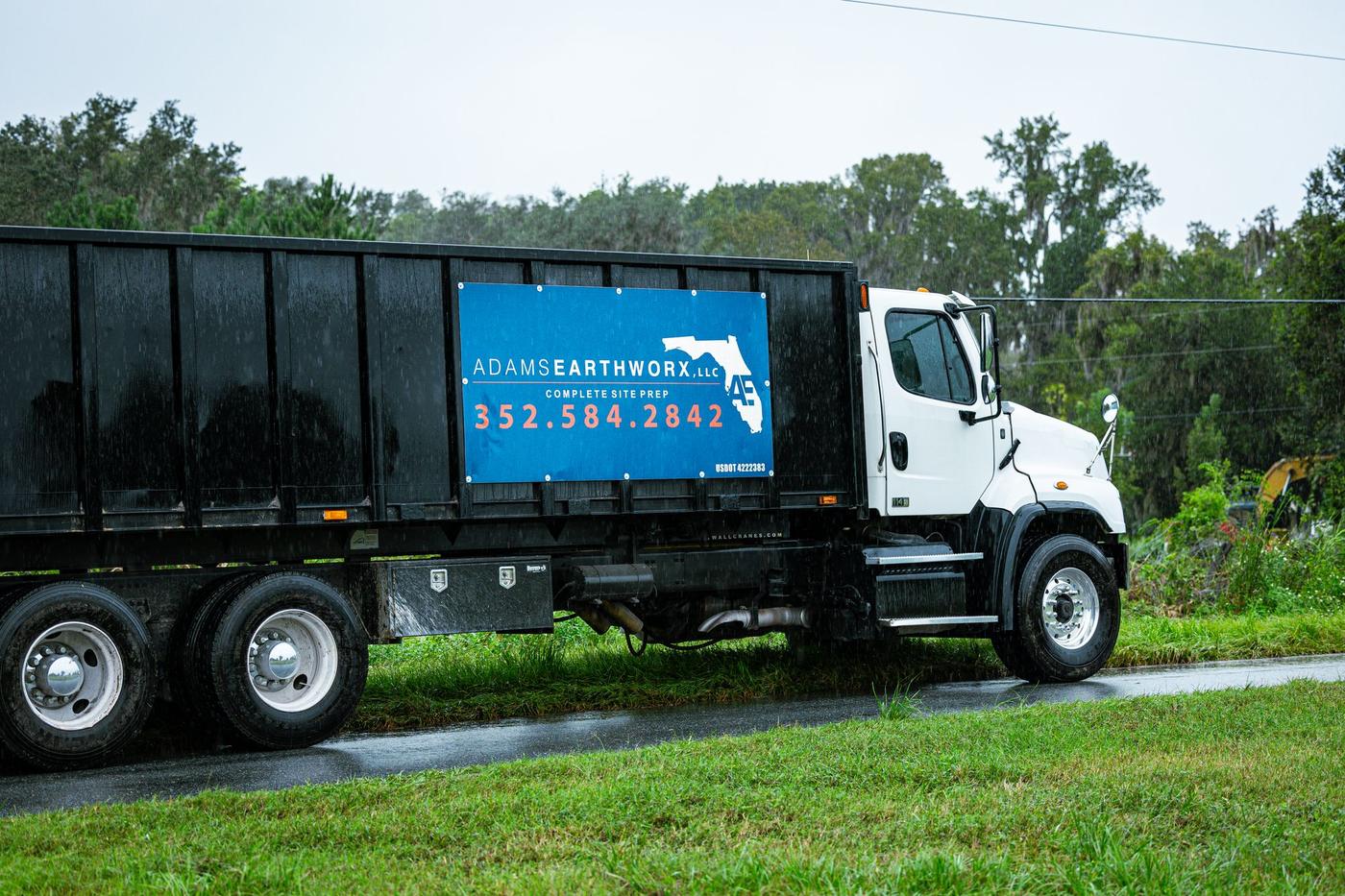
On a small lot there’s no back forty to pile brush on, so haul-off matters. The dump truck is in-house, and the same outfit that clears the lot also grubs it, rough grades it and lays driveway base. That’s the same one-outfit approach as the Dade City subdivision entrance, 2026: cleared, cut, graded, based, and paved by one outfit. One phone number, start to finish.
Ethan W., in a customer review: “Sam is extremely professional in his field and very knowledgeable”.
Related work: land clearing · grading and site prep · driveways and road base · what happens after the trees are down.
QUESTIONS
What part of my lot has to be cleared to build a house?
Only the build area: the house outline plus working room, the drive from the street, the septic and well spots, and room for the builder to stage. The rest of the lot can stay wooded. Your survey and house plan draw those lines, and Sam clears to them.
Do I need a permit to clear trees on my vacant lot?
It depends on the county and the lot, so ask before anything is cut. Citrus’s Tree Preservation Standards page says the county doesn’t issue stand-alone land-clearing permits, only permits tied to building, and clearing trees without contacting the Building Division violates its land development code. Hernando’s house permit packet includes a clearing plan form, and Marion changed its tree rules in 2026. Check with your county first; bring it up when Sam walks the property.
Which trees should I keep when I clear for a house?
Keep healthy trees that stand clear of the house, the drive and the drainfield, especially big oaks away from the roofline. Hernando’s clearing plan form asks about specimen and majestic trees, so measure the large ones before anything comes down. Any tree that would hang over the roof is worth talking through on the walk.
How long does it take to clear land for a house?
Sam gives you a time frame after he walks the lot, because it depends on how thick the growth is, how many big stumps there are, and what has to be hauled away. A wet stretch of weather can push the start back, since soft sand and loaded trucks don’t mix.
The listing said no gopher tortoises on the lot. Do I still need to check before clearing?
Yes, because a listing only describes the day it was listed. FWC says work within 25 feet of a potentially occupied burrow needs a relocation permit first, and clearing first can trigger a disturbed-site permit. Walk the lot for burrows right before work, and check with FWC if you find one.
Should I clear the lot before I have a builder and a house plan?
Usually not, because without a house placement there are no real lines to clear to. You risk taking a tree the county counts or opening the spot the septic layout needed. Get the survey and the house placement first, then clear once.
Where does the rain on my lot have to go once it is cleared?
On a platted lot it usually heads to the swale along the street or to a shared swale between lots. Hernando’s lot grading rules say the house sits 12 inches above the swale flow line and side swales drain to the front or rear. Ask your builder for the grades; Sam rough-grades the lot to them.
Got a wooded lot and a house plan? Text the survey and a few photos to (352) 584-2842, and Sam will walk it and tell you what has to come out.