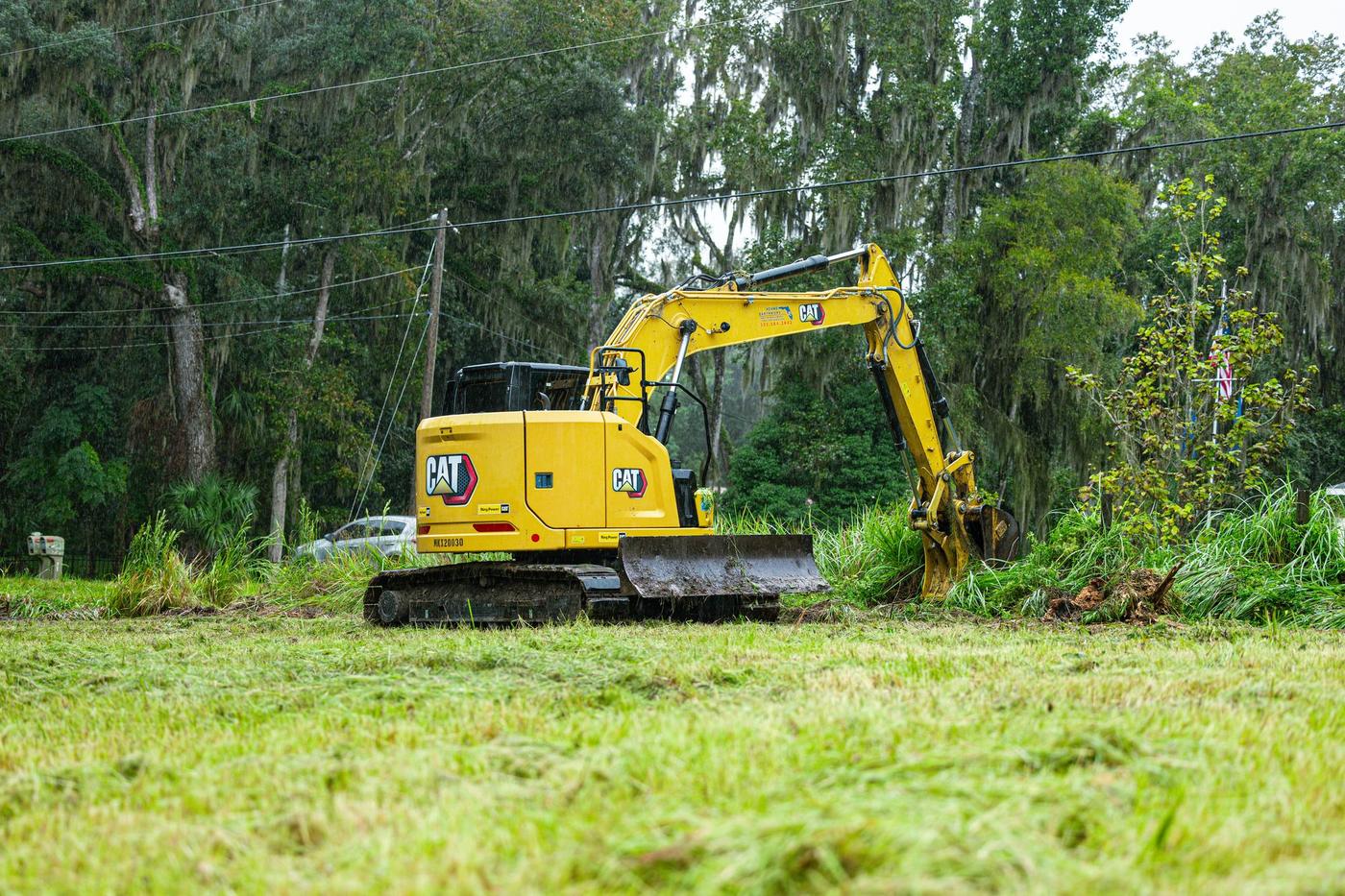
A culvert under a driveway is a short piece of pipe doing a big job: it lets the roadside swale keep carrying water while your car rolls over the top. On the Nature Coast, plenty of lots in Hernando and Citrus front a swale or a ditch, and that crossing is often where a drive gives out first. Adams Earthworx is Sam Adams’s outfit in Brooksville, FL, and Sam is the owner-operator who runs the excavator himself. This guide covers the crossing only: who signs off on it, how it goes in, how it fails, and when a clogged pipe can be saved. Text photos of both pipe ends to (352) 584-2842 and Sam replies the same day.
Why the swale is there and why you can't just fill it
That shallow ditch along the road is not wasted ground. It takes the water off the pavement, and usually off your neighbors’ frontage too, and moves it down the line to wherever the road drains. Your lot is one link in that chain.
Fill the swale flat in front of your lot and the water still comes. It just has nowhere to go. It stacks up on the upstream side, spreads into your yard or the neighbor’s, or sits on the edge of the road. That is why the fix is a pipe under the drive, not a pile of dirt in the ditch. The pipe keeps the swale open underneath while the driveway crosses over it.
Who has to approve it
The crossing is the one part of your driveway that is only half yours. In most cases it sits in the county right of way, between your property line and the road, so the county has a say in it. Check with your county first, before anything gets dug.
- Hernando County. The county’s Right of Way Use Permit page says all work in the county right of way needs prior approval from Public Works, and Public Works inspects and approves the work.
- Citrus County. Citrus County’s right-of-way application sends the work through Public Works Engineering. Call the county to confirm that is still the process.
- A state road. If your lot fronts a state road, the connection goes through an FDOT driveway connection permit, not the county.
- Anywhere else. Call your county before work starts and ask what they want to see for a driveway crossing.
Bring it up when Sam walks the property. He can tell you what the ground and the water are doing. The approval itself belongs to you and your county.
How a crossing gets built
The method matters more than the pipe. A sound pipe set on soft ground, or left with thin cover, fails like a bad one. Done right, the order goes like this.
1. Find the flow line
The flow line is the low path the water already takes down the swale. The trench follows it, so the pipe sits where the water runs, not above it and not buried below it.
2. Give the pipe a firm bottom
Soft muck or loose sand under a pipe lets it sag. The bottom of the trench gets cleaned out and firmed up so the pipe sits straight and stays that way.
3. Backfill a layer at a time
Dirt goes back around the pipe in thin layers, and each layer gets packed down before the next one goes on. Packing the sides is what holds the pipe round once weight comes on it.
4. Get enough cover on it
There has to be enough packed dirt over the pipe before any base goes on. A pipe sitting right under the rock takes every truck tire straight on the pipe wall.
5. Build the apron
The apron is the stretch of drive from the road edge over the pipe. It gets built up with compacted base, or whatever surface the county calls for in its right of way.
6. Finish the ends
The dirt at each end gets shaped and dressed so water goes into the pipe and out the other side, not around the outside of it. Some roads call for a mitered end, which is a slanted end cut to match the swale bank, or a headwall, which is a small wall at the pipe mouth; that is the county’s call, so ask them. The ends are often where the trouble starts.
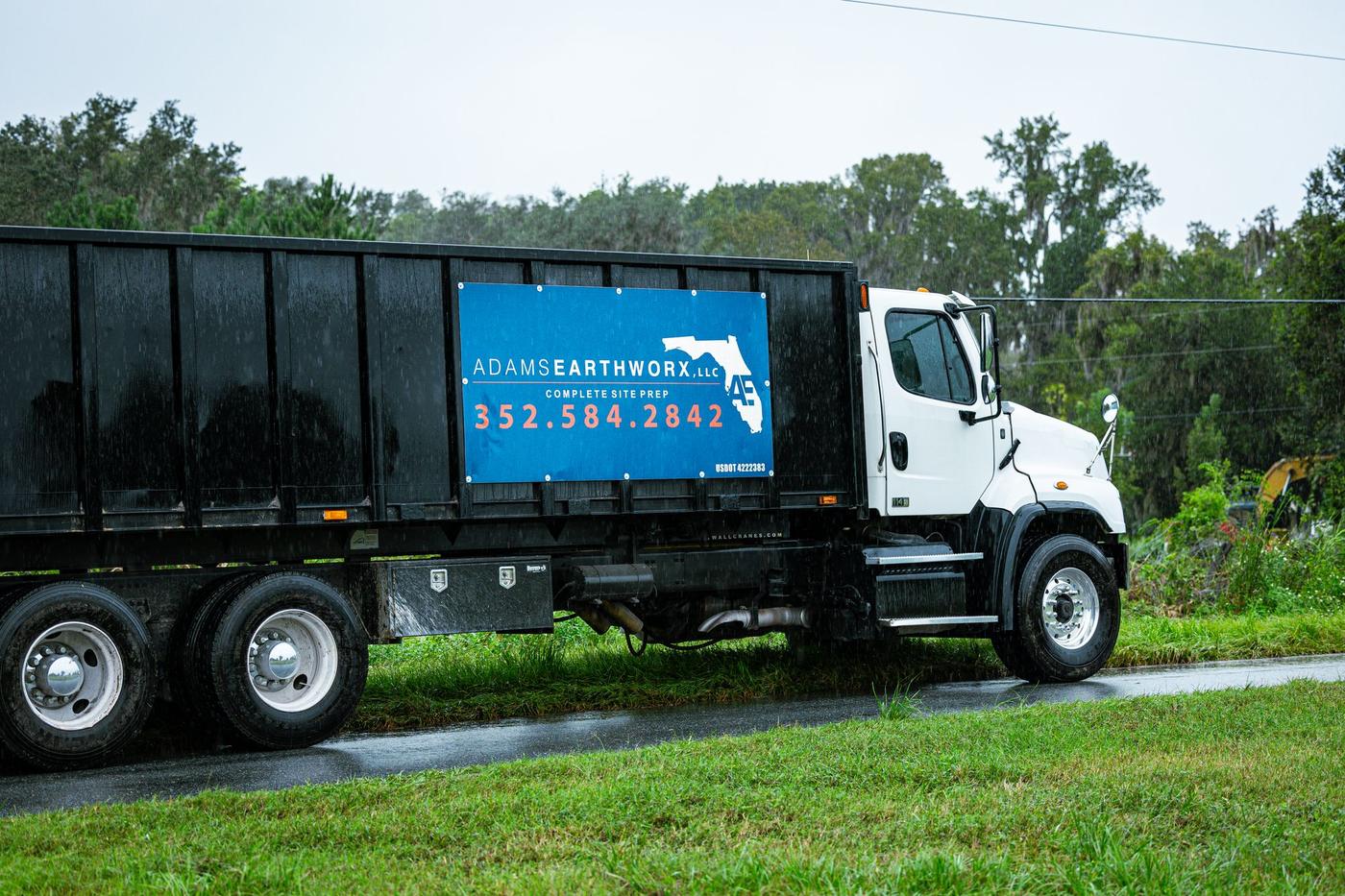
Base material comes in on our own dump truck, so the dirt work and the base come from the same outfit. The rest of the drive past the apron is covered on our driveways and road base page.
How driveway culverts fail
Walk out after a hard rain and look at both ends of the pipe. Most failures show themselves in one of these ways.
- Crushed pipe. Too little dirt over the top, or heavy trucks rolling over a pipe that was never covered enough. The opening goes oval or flat and the water backs up.
- Undermined ends. Water runs around the outside of the pipe instead of through it and carves out the dirt at the ends. You see a hole forming beside the pipe mouth or the edge of the drive caving in.
- Pipe set too high. If the pipe sits above the swale’s low line, water ponds on the upstream side and only drains through once it rises to the pipe. Standing water in front of the pipe days after a rain is the sign.
- Pipe packed with sand and leaves. Florida sand washes in a little with every storm. Over a few seasons the opening shrinks until little water gets through.
- Apron settled into a dip. When the dirt over the pipe sinks, the drive drops into a low spot. Water then runs down the driveway instead of along the swale, and the washout starts there.
Clean it out or replace it
A pipe that is clogged but still round and straight can often be cleared. If you look through it and see sand and leaves, but the pipe itself is whole and both ends sit right, cleaning it out and fixing the ends may be all it needs.
A pipe that is crushed, cracked or sagging in the middle comes out. You can’t clean your way past a pipe that has lost its shape, and a sag holds sand and water no matter how many times it gets flushed. If the pipe sits too high for the swale, it comes out too, because cleaning doesn’t change where it sits.
Sometimes the pipe is fine and the problem is everything around it: ends washed out, apron sunk. That is dirt and base work, and it gets fixed by rebuilding the ends and the apron the right way.
Who this is for
You just bought a lot with a swale out front
There is no entrance yet, and you need one before the builder’s trucks can get in. Settle the crossing with your county first, then the drive gets built from the road in.
Water runs over your driveway after every storm
The pipe is probably full, too high or crushed. Look at both ends after the next rain and send photos.
The dirt keeps caving in at the ends
Water is getting around the pipe instead of through it. That gets worse every season until the edge of the drive goes with it.
You're a small builder with slab and framing loads coming
You need a truck-ready entrance before the first concrete truck. A crossing that sinks under the first load holds up the whole job. Bigger entrance work is on our subdivision and commercial sitework page.
One job we can name. Dade City subdivision entrance, 2026: cleared, cut, graded, based, and paved by one outfit.
What happens when you text Sam
Text (352) 584-2842. Sam replies the same day and the estimate is free. For a crossing, these photos tell him the most.
- Both ends of the pipe. Shot straight on, so he can see how open each end is.
- The swale after a rain. Where the water stands and which way it is moving.
- The apron. From the road, so any dip or broken edge shows up.
- A wide shot of the frontage. The road, the swale and the drive in one picture.
Then Sam walks the crossing in person and watches where the water goes, upstream and down. What the swale needs gets decided on the ground, with your county’s answer in hand.
Related work: driveways and road base · driveways in Spring Hill · driveways in Weeki Wachee · driveways in Inverness · excavating · subdivision and commercial sitework.
QUESTIONS
Who has to approve a culvert where my driveway crosses the roadside swale?
Check with your county first, because the crossing usually sits in the county right of way. Hernando County’s Right of Way Use Permit page says all work in the county right of way needs prior approval from Public Works, and Public Works inspects and approves it. Citrus County’s right-of-way application sends the work through Public Works Engineering; call to confirm that is still the process. If your lot is on a state road, the connection goes through an FDOT driveway connection permit instead of the county. Bring it up when Sam walks the property.
What size pipe does my driveway culvert need?
It depends on the water that swale carries and on what your county asks for, so ask the county and let Sam look at the swale. No size gets guessed on a web page. Two lots on the same road can carry very different water.
My culvert is clogged and water runs over the driveway after a rain. Can it be cleaned out, or does it have to be replaced?
If the pipe is still round, straight and set at the right height, it can often be cleaned out. If it is crushed, cracked, sagging or set too high for the swale, it has to come out. Photos of both ends after a rain usually show which one you have.
Why is the dirt washing out around the ends of my culvert pipe?
The dirt washes out because water is running around the outside of the pipe instead of through it. That happens when the ends were never shaped to steer water into the pipe, or when the pipe is clogged or set high enough that water looks for another way. The ends and the flow are what need fixing; more dirt piled at the ends alone will not hold.
Can I just fill in the ditch in front of my lot instead of putting in a pipe?
No, filling the swale blocks water that has to get through. The road and your neighbors still drain that way, so the water backs up onto your lot, theirs, or the road. A pipe keeps the swale working under the drive.
How do you keep trucks from crushing the pipe under the driveway?
The usual protection is a firm bottom, packed dirt on the sides and enough cover over the top. The backfill goes in a layer at a time and gets compacted, then the apron gets built up with compacted base or whatever surface the county calls for. That spreads the weight through the dirt instead of putting it straight on the pipe wall.
What should I send Sam so he can tell me what my culvert crossing needs?
Send photos of both pipe ends, the swale after a rain, the apron from the road, and one wide shot of the frontage. Text them to Adams Earthworx in Brooksville, FL at (352) 584-2842. Sam replies the same day, and estimates are free.
Text photos of both ends of your culvert to (352) 584-2842 and Sam will tell you what the crossing needs.